
AI/ML
For Biomarker Discovery
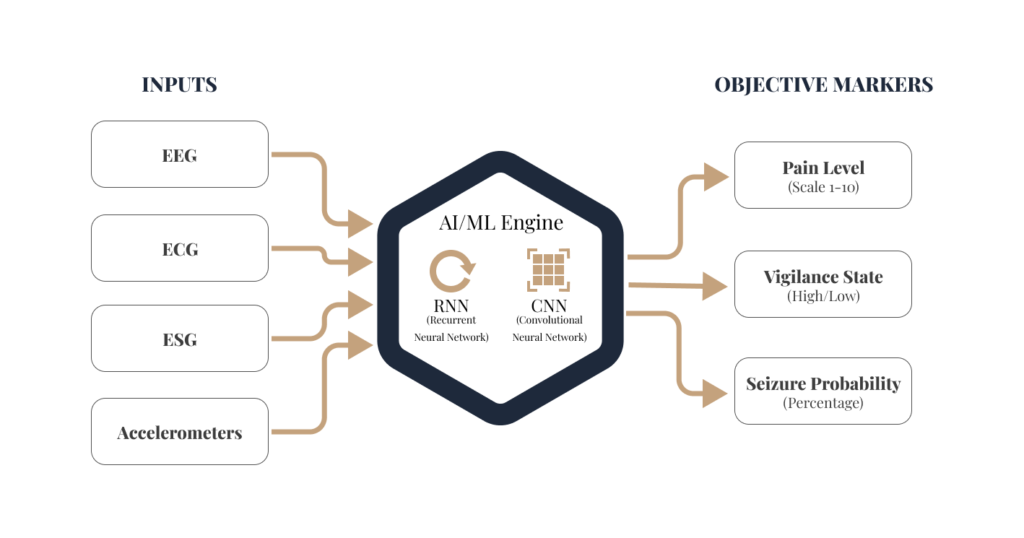
Our lab leverages cutting-edge Artificial Intelligence (AI) and Machine Learning (ML) to transform subjective patient experiences into objective, measurable biomarkers. By integrating multi-modal data from neural and physiological sources, we develop predictive models that define “neural signatures” for complex conditions like drug-resistant epilepsy and chronic pain.
Building on our PI’s prior work in closed-loop neuromodulation and biomarker development (including contributions to 16 clinical trials), we are establishing a scalable AI/ML pipeline for multimodal neurophysiology.
Bridging the Gap with Multimodal Integration
Traditional diagnostics often rely on intermittent snapshots of a patient’s state. Our approach utilizes continuous, multi-modal sensing to create a comprehensive profile of a patient’s health.
Neural Signals
We analyze high-resolution data from EEG, Electrospinogram (ESG), Evoked Potentials (EPs), and Local Field Potentials (LFPs) to assess real-time network reactivity.
Physiological & Behavioral Data
Our algorithms integrate cardiovascular and autonomic signals to identify physiological correlates of disease states.
Sensor Fusion
Using AI, we fuse these disparate data streams—ranging from central nervous system (CNS) signals to peripheral wearables—to quantify behavioral function and its impairment by underlying conditions.
Advanced Algorithmic Frameworks
We employ a variety of advanced ML architectures tailored to the specific dynamics of the human nervous system:
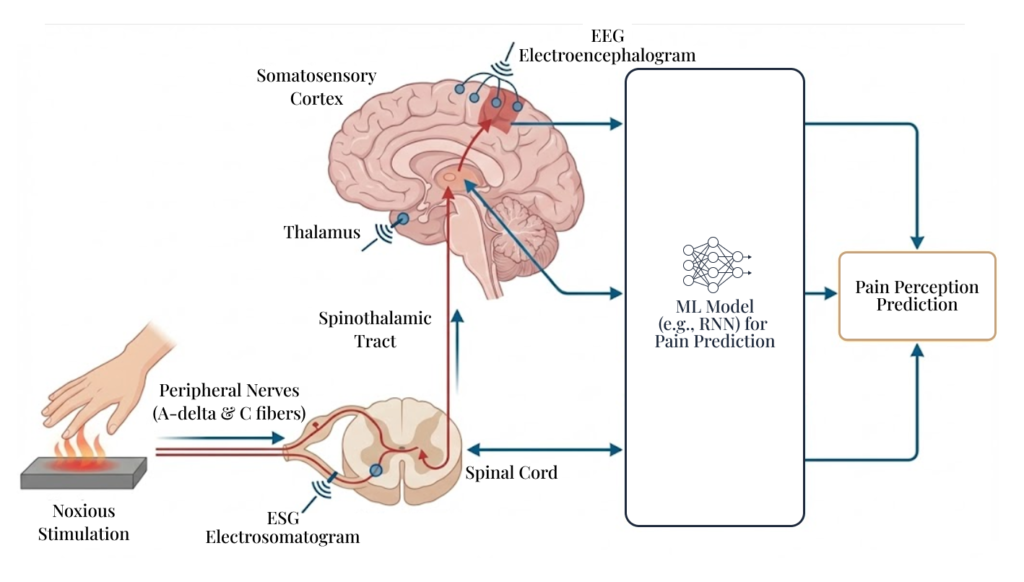
Recurrent Neural Networks (RNN) & BiLSTM
Used for dissociative modeling of behaviorally relevant dynamics, enabling high accuracy for applications like event detection, state classification, seizure detection, and trend/change detection.
Convolutional Neural Networks (CNN)
Utilized for automated event detection in biosignals by extracting multiscale temporal features.
Linear SVM Classifiers
Applied to ESG (Electrospinogram) features, such as Line Length (LL) and Area Under the Curve (AUC), to classify seizure states in real-time.
Deep Learning for Pain
We develop models that aim to identify objective pain biomarkers by linking signals across the spinal cord, thalamus, and cortex.
Clinical Translation & Impact
Our AI/ML tools are designed to expedite clinical translation and improve patient outcomes.
AI x Clinical Trials
We use predictive modeling to increase the efficiency and effectiveness of clinical trials, including enhanced screening during enrollment, allowing faster validation of new therapies.
Closed-Loop Optimization
By identifying biomarkers in real-time, our systems can automatically adjust neurostimulation “doses,” to help maintain effectiveness even as the patient’s state changes.
Personalized Models
We move beyond “one-size-fits-all” treatments by developing patient-specific models that account for individual variability in neural signatures.