Our
Closed-Loop Architecture
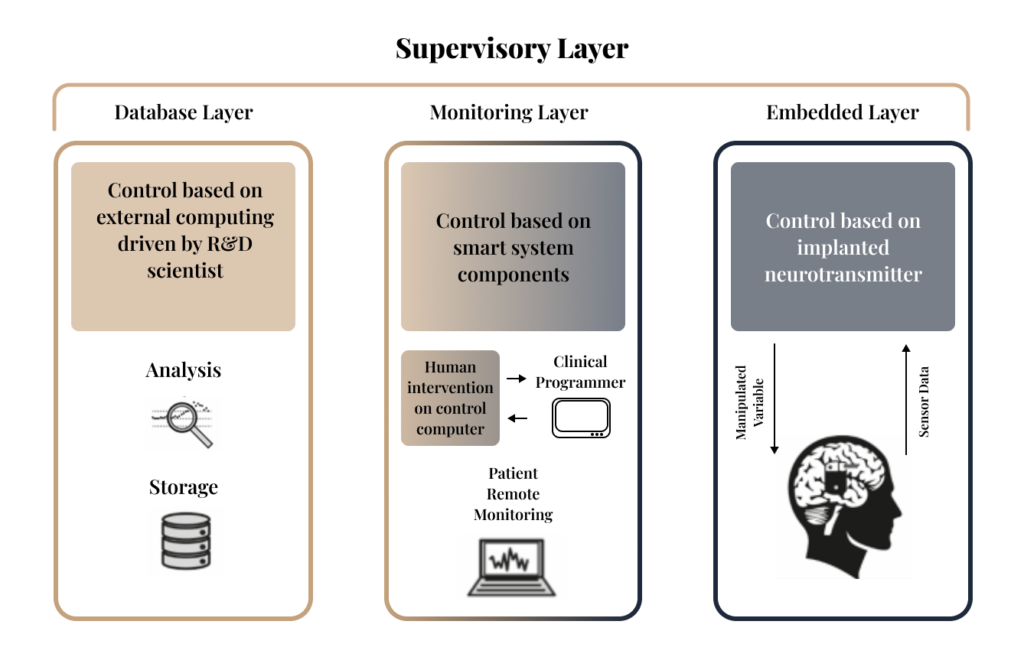
A closed-loop system is an intelligent feedback loop designed to monitor a patient's biological state and adjust therapy automatically. Our architecture organizes this process into three integrated layers:
2026 Marks V. et. al.…Esteller R…Denison T, “Principles of Physiological Closed-Loop Controllers in Neuromodulation” Manuscript under revision.
2000 Esteller R., Echauz J., et. al., US20070142873 A1, Adaptive Method and Apparatus for Forecasting and Controlling Neurological Disturbances under a multi-level control.
Decades of Static Stimulation
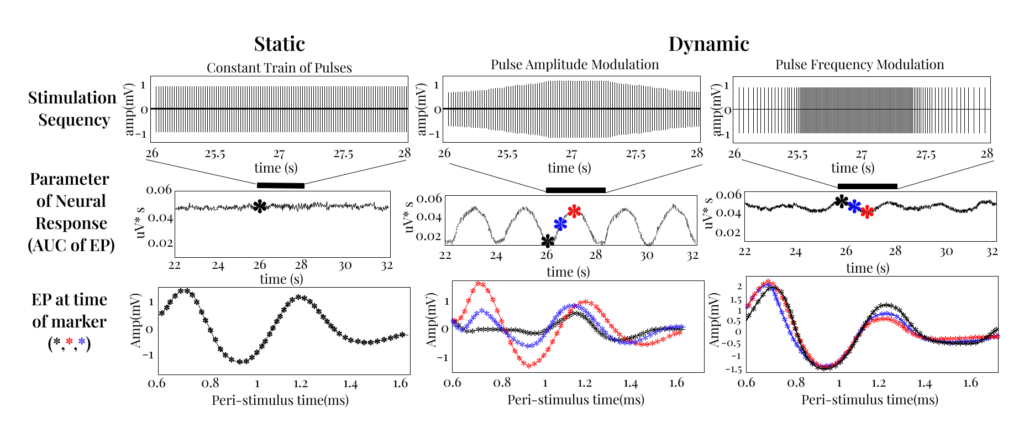
For decades, most clinical neuromodulation has relied on time-invariant stimulation parameters.
What We Do: Transitioning from Static to Dynamic
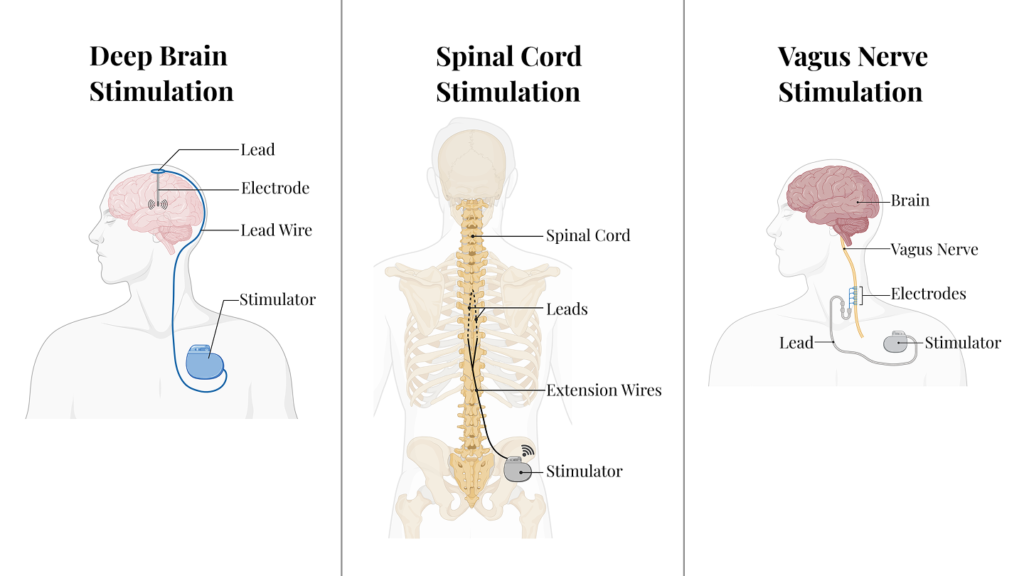
While traditional Deep Brain Stimulation (DBS), Spinal Cord Stimulation (SCS), and Vagus Nerve Stimulation (VNS) have historically relied on static pulses, our lab is advancing Dynamic Stimulation to improve patient outcomes. Our PI started these efforts with the Dynamo Study, and we are actively expanding this line of work to other neurological conditions beyond chronic pain, and understanding the physiological and behavioral mechanisms of action.
Encoding Time-Varying Stimulation Patterns Across Time and/or Space
We replace constant pulses with time-varying patterns. We modulate different signal parameters to drive neural activity:
By modulating these variables, we precisely manage the Dose—the total charge delivered—to ensure maximal safety and efficacy:
$$i_{rms}(t)=\sqrt{\frac{1}{T}\int_{0}^{T}i(t)^{2}dt}$$
Changing neural activation with pulse amplitude modulation in Swine
Building on our PI’s prior preclinical experience (including large-animal studies), we highlight a clear limitation of purely static stimulation and the opportunity enabled by time-varying stimulation patterns:
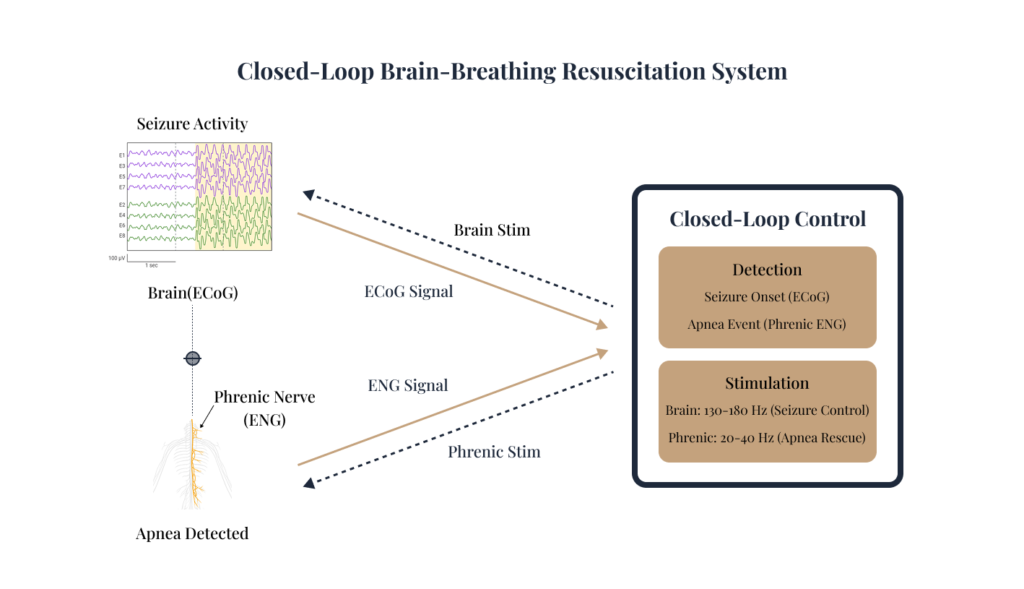
Closed-Loop Neuro-Respiratory Safety Concept
Our Closed-Loop Resuscitation System is a research concept that explores an integrated interface between the brain and the respiratory system. By integrating real-time neural and respiratory sensing, the system is designed to detect and respond to high-risk events:
This early-stage concept is focused on feasibility, safety constraints, and algorithm design for coordinated neuro-respiratory intervention.